June 17, 2026
The Cloud Has a Sound
Residents near data centers report a persistent low-frequency hum as AI infrastructure turns the invisible cloud into a physical neighbor.
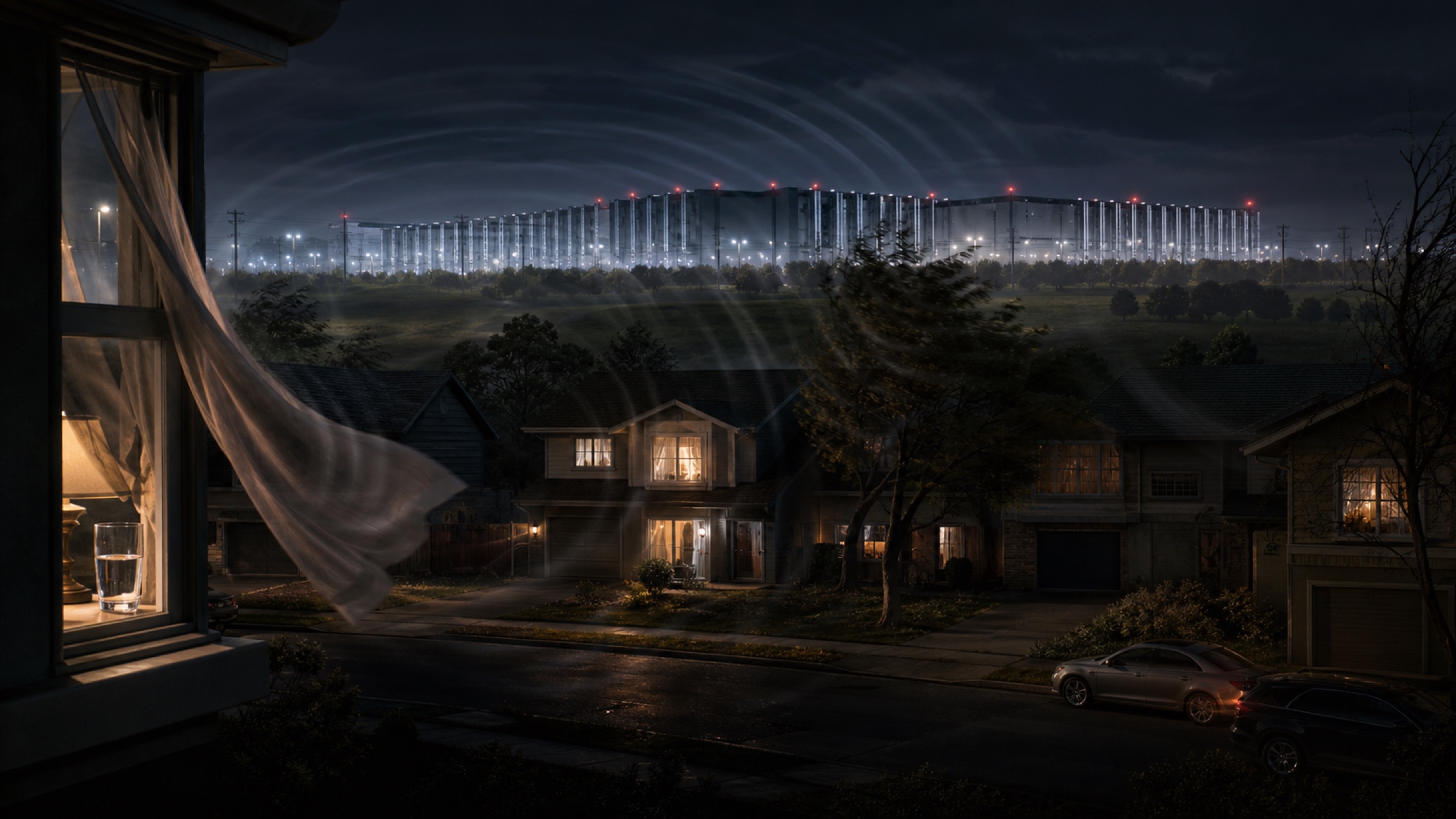
The cloud was sold as weightless infrastructure, but AI is making it painfully physical for people living beside data centers. Residents describe a low, persistent vibration from cooling systems, fans, transformers, and backup equipment. It can pass through walls, survive closed windows, and become harder to ignore at night when everything else stops.
The New York Times reported on residents in several U.S. communities who have taken their complaints to court. Their experience gives AI infrastructure a physical form: large industrial buildings operating around the clock beside homes that were never designed to share a property line with them.
Permanent Hum
Data centers require enormous airflow. Servers produce heat continuously, and cooling equipment must move that heat away. Diesel generators undergo testing. Electrical systems vibrate. The resulting sound can include low frequencies that travel differently from ordinary traffic or construction noise.
Residents report sleep disruption, headaches, stress, and the sensation of vibration inside their homes. Those experiences deserve careful attribution; a reported symptom is not proof of medical causation.
The legal record is firmer. Noise complaints and lawsuits show that communities and operators disagree over what counts as acceptable industrial sound, how it should be measured, and who must pay to reduce it.
Infrastructure Boom
AI intensifies a buildout already driven by cloud services and streaming. The Times cited an analysis counting more than 3,000 operating U.S. data centers and over 1,500 in development.
Each project brings jobs, tax revenue, and computing capacity. It also brings power lines, water demand, generators, cooling systems, traffic, and sound. The benefits can spread across a region while the burden concentrates on the nearest streets.
Developers can reduce noise through site selection, acoustic walls, low-noise fan systems, equipment placement, and enforceable operating limits. Those choices become more expensive after a facility is built.
Physical Cloud
“The cloud” was always a marketing abstraction. Files, models, and video streams live in buildings filled with machinery. AI makes those buildings larger, denser, and more numerous.
Communities are beginning to negotiate accordingly. The next data-center deal will be judged on taxes and jobs alongside decibels, water, power, and distance from homes.
Digital life has acquired an industrial soundtrack. The people living beside it cannot mute the volume.