February 27, 2026
More AI, Dumber People?
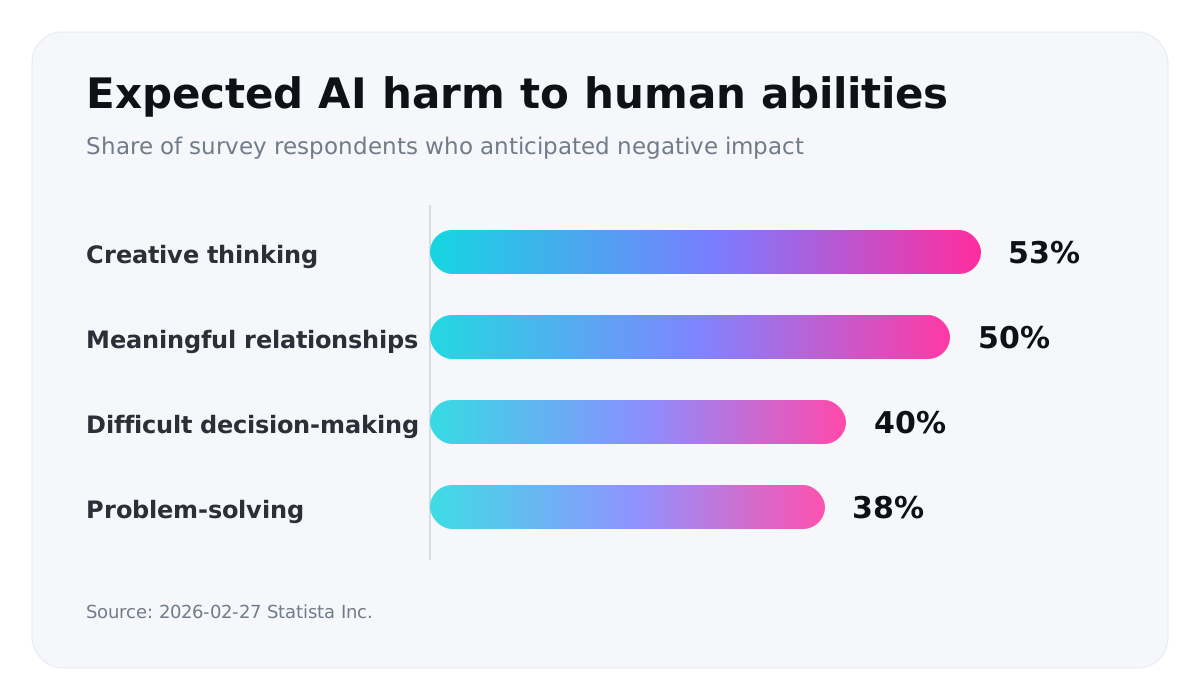
Survey respondents expect AI to weaken creative thinking, difficult decisions, problem-solving, and meaningful human relationships.

Public anxiety about AI has moved beyond job loss and into a more intimate fear: that outsourcing everyday thinking may weaken the mental habits people still need. Statista summarized survey results showing that 53% of respondents anticipated harm to creative thinking, 40% to difficult decision-making, 38% to problem-solving, and 50% to meaningful relationships.
Those answers measure expectations, not proof that AI has already made people less capable. The signal is still useful. People are beginning to suspect that cognitive convenience has a cost, especially when the same tools that answer questions also decide which questions feel worth asking.
Cognitive Offload
The concern has a familiar logic. Tools that remove effort can also remove practice. Navigation apps weaken route memory. Autocorrect changes spelling habits. Calculators reduce mental arithmetic.
AI reaches further because it can draft, summarize, recommend, explain, and decide. A user can outsource the blank page and the argument that belongs on it.
That can save time. It can also disguise weak understanding behind fluent output.
Use or Surrender
The effect depends on how the tool enters the task. Asking an AI system to challenge a plan can sharpen judgment. Asking it to produce the plan before any human thought begins can narrow the user’s role to approval.
Education makes the difference visible. A student who uses AI to test an argument still wrestles with the material. A student who submits an answer without understanding it gains a document and loses the practice.
Workplaces face the same choice. Speed metrics reward output immediately, while lost expertise appears later when nobody can diagnose an error, train a newcomer, or act without the system.
Reasoning Recession
Reasoning Recession describes the atrophy of practiced judgment: fewer opportunities to struggle with ambiguity, make a difficult call, and learn from the result.
The Statista figures show that the public already senses the tradeoff. Half of respondents also feared damage to meaningful relationships, a reminder that cognition is not the only faculty people worry about outsourcing.
AI can carry part of the load. Humans still need regular reps.