July 14, 2026
Images Are No Longer Evidence
AI-edited images, deepfakes, provenance labels, and official synthetic media are forcing a new question: who can prove what actually happened?
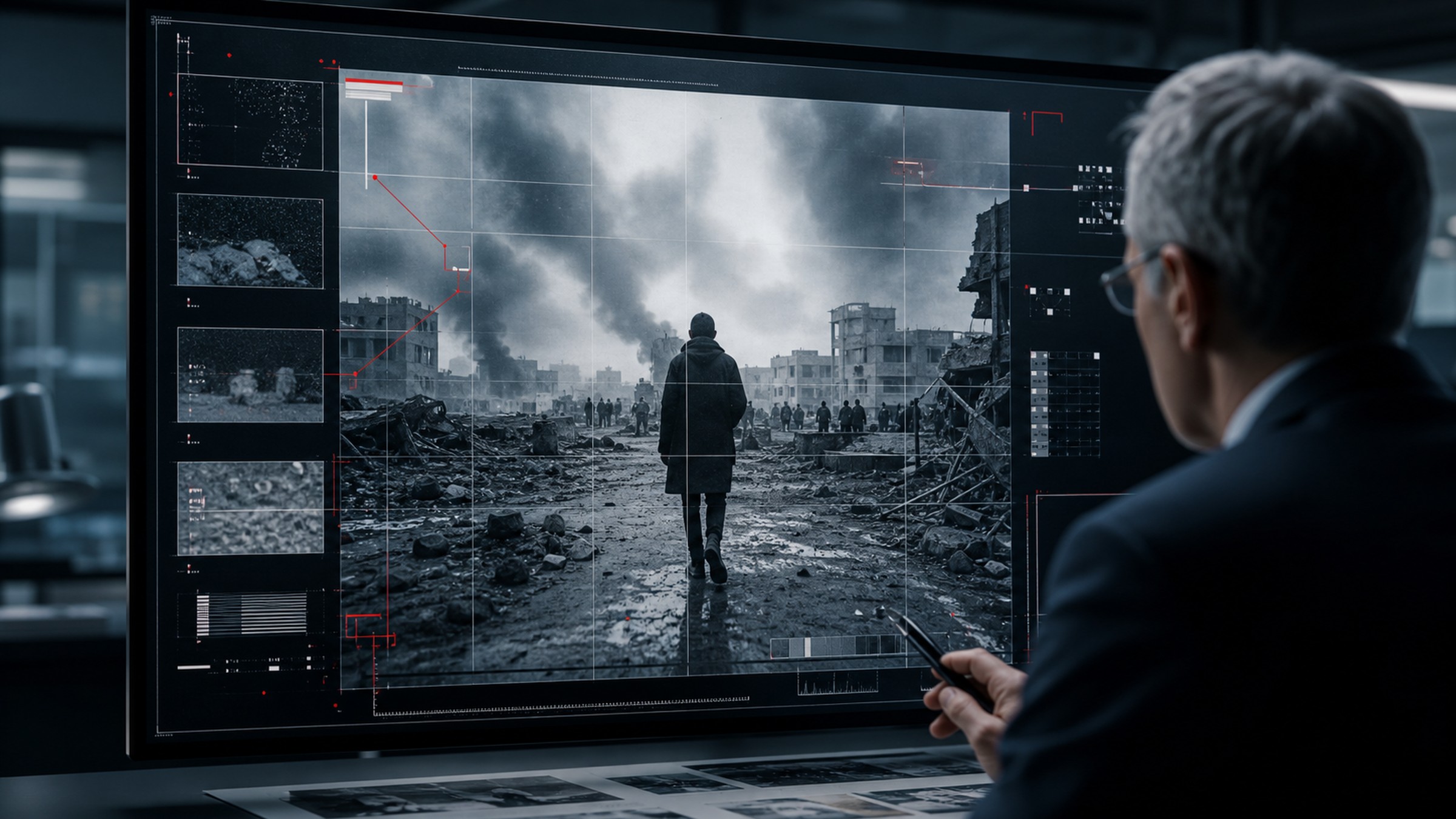
Images used to carry civic authority: courtroom exhibit, news proof, family receipt, eyewitness record. That authority now has to be earned. Synthetic Authenticity tracks the point where visual media can still look convincing while trust moves to provenance, labeling, source reputation, context, and the machinery behind the image.
The shift is bigger than fake pictures. Once images become programmable, the picture becomes an opening claim, not the proof. The new burden falls on the chain of custody behind it.
Forgery Scales Up
Image manipulation has a long history. Stalin erased enemies from photographs. Photoshop made digital alteration a desktop skill in 1990. The current break is speed, realism, and access.
In 2019, the Center for Strategic and International Studies warned that deepfakes had become realistic audio and video forgeries produced by AI. CSIS traced the public arrival of the term “deepfake” to 2017 and warned that the technology was becoming cheaper, faster, and easier to use. It also made the core problem plain: screens do not give people a reliable way to separate real from false. CSIS, October 23, 2019
That was the historical signal. Synthetic media had moved from image trickery into evidence collapse.
Tools Go Mainstream
The inflection point came when synthetic editing entered normal creative software.
In May 2023, Adobe announced generative fill for Photoshop, giving users a prompt-based way to add objects, remove objects, change backgrounds, extend images, and create new visual material inside the world’s best-known image-editing tool. Axios reported that Firefly, Adobe’s generative AI system, had already been used to create more than 100 million images since March 2023. Axios, May 23, 2023
Adobe’s answer was provenance. Its Content Authenticity Initiative was designed to track where an image began and how it changed. That tells us where the market is heading. The future of trust is less about spotting every fake by eye and more about preserving the chain of custody.
An image without provenance will start to feel like food without an ingredient label.
Official Channels Blur
The public risk rises when synthetic media comes from institutions people are supposed to trust.
In January 2026, the Associated Press reported on AI-edited imagery shared through official White House channels, including an altered realistic image of civil rights attorney Nekima Levy Armstrong after her arrest. The AP story framed the issue as a new boundary in official communication: realistic synthetic imagery was no longer limited to anonymous accounts, spam networks, or partisan fringe pages. Associated Press, January 27, 2026
That changes the burden on the viewer. The old question was whether a random image online could be trusted. The sharper question is what happens when institutions treat synthetic imagery as normal persuasion.
Media literacy helps. It does not solve the institutional problem. Most people will not inspect metadata, trace upload history, compare source frames, or understand forensic artifacts while scrolling a feed.
Labels Help
Labeling synthetic content works, but it creates a second-order problem.
A 2026 paper in the Proceedings of the International AAAI Conference on Web and Social Media tested how AI labels change perceived authenticity. In a preregistered experiment with 877 participants in Germany, researchers showed Instagram-style posts containing AI-generated or AI-altered images. Labels such as “AI-generated” and “misleading” reduced perceived authenticity. ICWSM/AAAI, May 25, 2026
The study also found an implied authenticity effect: when some posts were labeled, unlabeled images received a small trust boost.
That is the trap. Labels can warn people about synthetic content, but they may also train viewers to treat anything unlabeled as clean. In a polluted media system, silence becomes a signal. Sometimes a false one.
Provenance Era
Synthetic Authenticity is not the claim that every image is fake. That would be lazy paranoia, and worse, useful to liars. The real shift is that authenticity now has to be demonstrated.
The evidentiary stack is changing:
- Who created the image?
- What tool touched it?
- What changed?
- When did it change?
- Who published it first?
- Which institution, platform, or archive preserved the provenance?
- What happens if the image is stripped of that history?
Digital Lifestyle began as the merger of people, devices, screens, software, and networks. Synthetic Authenticity is one of its harder consequences. Once images become programmable, reality needs a receipt.
The image still matters. It just has to bring witnesses.