July 14, 2026
Cheerleading Finally Gets a Scoreboard
Cheerleading’s move from sideline performance to scored championship sport reveals the rising stakes of spectacle, athletic risk, and institutional recognition.
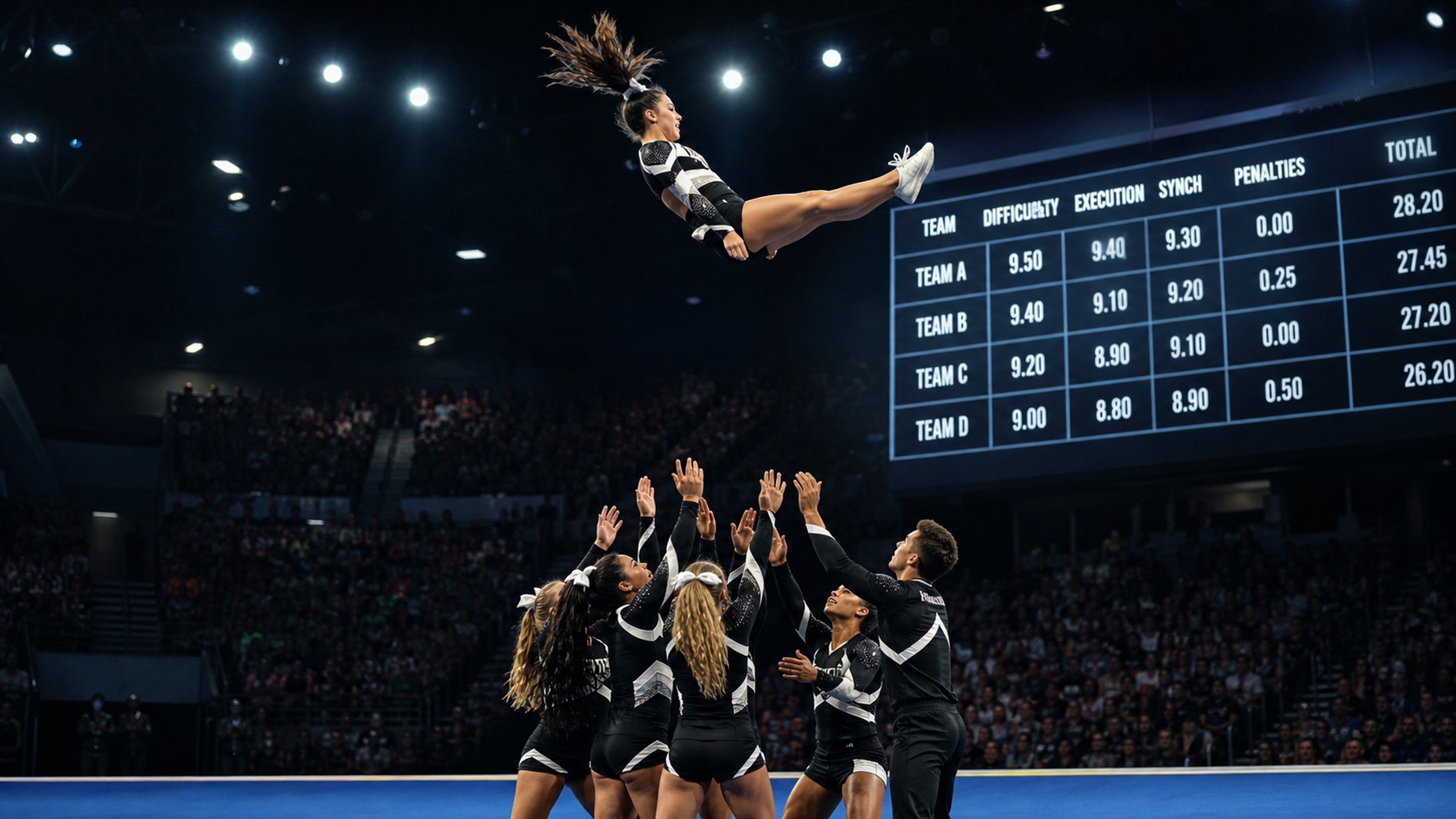
Cheerleading spent decades trapped in the wrong mental category: too athletic to be dismissed as school spirit, too associated with the sideline to be treated as the game itself. For athletes, coaches, insurers, parents, and emergency rooms, the activity already looked like speed, flight, impact, choreography, repetition, trust, and real risk. The institutions are finally catching up to what the bodies have been doing all along.
Perilous Pom Poms tracks cheerleading’s transformation from sideline spectacle into recognized athletic competition. The story is about legitimacy, but also about a culture that keeps turning performance into higher-stakes experience.
Sideline Myth
The old image was simple: smiles, uniforms, chants, school spirit.
Competitive cheerleading broke that image. Stunts, pyramids, basket tosses, tumbling passes, and synchronized routines moved the activity into a different physical category. The athlete became performer, acrobat, teammate, and risk manager at once.
In March 2020, TIME described the contradiction around competitive cheer. The sport had become physically demanding and dangerous, yet official recognition lagged behind the athletic reality. TIME reported that long-term catastrophic injury totals ranked cheerleading behind only football. TIME, March 4, 2020
That gap matters because recognition changes infrastructure. It affects coaching standards, safety rules, medical oversight, funding, recruiting, insurance, and how seriously injuries are tracked.
For years, cheerleading carried the risk profile of a sport without always getting the institutional machinery of one.
Olympic Door
The institutional frame shifted in July 2021.
Cheer Canada announced that the International Cheer Union received full recognition from the International Olympic Committee during the IOC’s 138th session in Tokyo. The decision made cheerleading eligible for future Olympic inclusion. Cheer Canada also noted that the ICU had grown to 116 member nations and had developed standardized rules, training programs, and safety programs. Cheer Canada, July 24, 2021
That recognition did not put cheerleading in the Olympics overnight. It did something more structural. It moved cheer into the Olympic conversation as a governed, international sport.
Generation X-tasy is the Ubertrend of heightened experience: bigger spectacle, stronger sensations, more immersive entertainment, more intense competition. Cheerleading fits because it fuses athletic danger with performance culture. The point is not excess for its own sake. The point is the experience economy entering the gym.
STUNT Arrives
The next step was a scoreboard.
STUNT was created to separate cheerleading’s athletic skills from the sideline role that long confused the category. Its format takes partner stunts, pyramids, jumps, tumbling, tosses, and team routines, then turns them into a head-to-head contest with scored rounds.
That distinction matters in NCAA history. Traditional cheerleading support roles sat uneasily inside the college-sports system, while STUNT gave the NCAA a clearer competitive structure to evaluate: defined routines, direct opponents, scoring, divisions, championships, and a sport-specific governance path.
In January 2026, the NCAA announced that STUNT had earned championship status across all three divisions. NCAA, January 16, 2026
That format changes how the public reads the activity. A routine can impress. A scored contest settles.
The scoreboard gives the answer.
Injury Ledger
Recognition does not erase the danger. It makes the danger harder to ignore.
A June 2026 systematic review in Frontiers in Sports and Active Living found that collegiate cheerleading is physically demanding, with injury rates ranging from 2.4 to 2.8 per 1,000 athlete-exposures among included studies. The review found sprains, strains, concussions, and fractures among the most common injury types. Stunting and practices were frequent contexts for injury, while catastrophic injuries predominantly involved the head and neck. Frontiers, June 17, 2026
The review also flagged a less visible problem: injury surveillance remains limited, outdated, and inconsistent.
That is the grown-up part of legitimacy. A sport cannot only claim medals, rankings, and highlight reels. It has to count the bodies too.
Performance Culture
Perilous Pom Poms is a deceptively cheerful name for a serious pattern.
Modern audiences reward athletic spectacle. They reward youth sports that look camera-ready, routines that travel well on social media, and competitions that compress drama into tight visual bursts. Cheerleading sits directly inside that appetite.
The stronger the spectacle gets, the more the sport needs adult systems around it: coaching standards, safety protocols, medical tracking, athlete protections, and honest language about risk.
Cheerleading finally has the scoreboard. Now the institutions have to prove they can keep score on everything else.