February 22, 2026
Can Creators Survive the Flood of AI Slop?
Tests of new YouTube and TikTok accounts found feeds crowded with cheap AI video, raising the cost of being seen for human creators.

The internet no longer has a production problem. It has a filtration problem. Generative video can produce clips at a speed and price no human studio can match, opening visual storytelling to more people while also making it cheap to flood feeds with repetitive material designed to harvest attention before anyone notices how little thought went into it.
AI slop is the name now attached to that output. The term works because it captures both abundance and contempt: a feed swollen with synthetic filler that competes with human work for the same seconds of attention, the same recommendation slots, and the same exhausted viewer.
One Test Feed
Kapwing defines AI slop as careless, low-quality content generated automatically and distributed to farm views, subscriptions, or political influence. Its 2025 YouTube study created a new account and examined the first 500 Shorts it received.
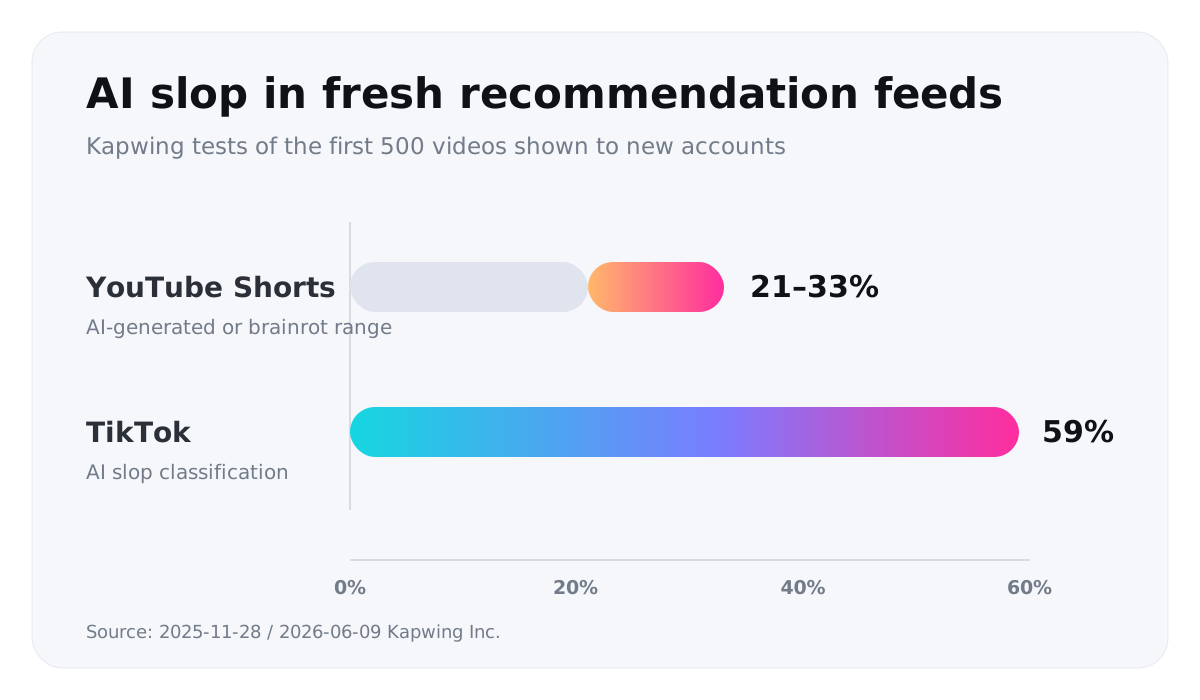
Researchers classified 104 videos, or 21%, as AI-generated. They classified 165, or 33%, as brainrot: compulsive, nonsensical, low-quality video. Because the categories overlap, adding them would misstate the result; the figures should remain a range.
As Kapwing put it: “Kapwing’s new research shows that 21-33% of YouTube’s feed may consist of AI slop or brainrot videos.” More precisely, that range describes one new-account test feed, not all viewing across YouTube.
The same experiment became more dramatic on TikTok. In a June 2026 study, Kapwing classified 294 of the first 500 videos shown to a fresh account, or 59%, as AI slop.
These are platform experiments, not audited platform-wide measurements. They still demonstrate how quickly synthetic material can dominate a blank recommendation profile.
Slop Scales
The economics reward volume. Kapwing found AI-slop channels with billions of views and millions of subscribers. Its estimates, drawn partly from Social Blade, put annual revenue for some channels in the millions.
One Indian channel, Bandar Apna Dost, had more than 2 billion views when Kapwing collected its data. A U.S.-based channel called Cuentos Facinantes had nearly 6 million subscribers. Neither needed the production machinery once associated with media at that scale.
Working creators now compete against an industrial stream of thumbnails, clips, cloned formats, and recurring characters that can be produced until the algorithm rewards one.
Human Premium
A TechCrunch discussion framed the dilemma clearly. AI video can give independent creators and small businesses production capabilities they could never afford. The same tools can saturate the market and make it harder for a new human voice to break through.
Established creators are already diversifying beyond advertising into products, licensing, events, and businesses they control. That strategy becomes more important when attention can be manufactured at enormous scale.
The flood may also create a premium for visible human effort. Process, personality, live performance, trusted communities, and a recognizable point of view signal human authorship.
Slopulism
Merriam-Webster naming “slop” its 2025 word of the year confirmed that the problem had escaped the technology press. The term now covers a broader cultural condition: abundant content with little care, accountability, or value.
Creators will not beat that system by producing more of the same material. Their advantage is the part automation cannot mass-produce convincingly: judgment, lived experience, taste, and trust.
AI made content nearly infinite. Scarcity has moved somewhere else.